You have hit a turning point. The business is growing, your team is expanding beyond 20 people and the IT challenges that used to be manageable are now starting to cost you time, money and sleep. The question sitting on your desk: do you hire a dedicated IT person or hand things over to an external IT support services provider?
Let's work through some of the key decision making factors.
The case for keeping IT in-house
There is genuine case in having someone on your team who knows your systems, your people and your business quirks. An internal IT staff member is always close by, invested in the company and can build relationships across the organisation over time.
The pros of an in-house IT person:
- Immediate physical presence: they are in the building when something breaks.
- Deep familiarity with your specific environment and business processes.
- Direct accountability to you as the employer or director.
- Can embed into the culture and build trust with staff.
For some businesses, these factors genuinely outweigh everything else. If your operations are highly specialised, your systems are custom-built or you have security or compliance reasons that require someone on-site full time, an internal hire may be the right call.
The cons of in-house IT:
- Single point of failure. One person means one set of skills, one availability window and one point of vulnerability if something goes wrong.
- Skills gaps are inevitable. No individual IT professional is equally expert in networking, cyber security, cloud platforms, compliance and helpdesk support. As your needs evolve, your internal hire will hit their ceiling.
- After-hours support is limited. Unless you are paying overtime, your IT coverage has a hard stop at 5pm.
- Training and certification costs never stop. Technology changes fast. Keeping one person current across everything your business needs is expensive and time-consuming.
- Recruitment is painful and costly. When your IT person leaves, you are looking at potentially $10,000 to $25,000 in recruitment costs, plus months of disruption while a new hire gets up to speed.
What an outsourced IT service provider can offer
An external IT support services provider or managed IT services provider (MSP) isn't just outsourced helpdesk. A good MSP becomes a strategic technology partner, proactively monitoring your systems, advising on what you actually need and bringing a full team of specialists to problems that would stump a single internal hire.
The pros of working with an MSP:
- Access to an entire team of IT specialists, not just one generalist.
- Predictable, fixed monthly costs, no surprise bills or budget blowouts.
- After-hours support included in your agreement.
- Proactive monitoring that catches problems before they become crises.
- Scalable coverage as your business grows, which means adding five new staff doesn't mean hiring another IT person.
- No recruitment risk, no leave gaps, no single point of failure.
- Built-in cyber security expertise, including frameworks like the Australian Government's Essential Eight.
For a business running on Microsoft 365 and cloud services but lacking the internal expertise to manage it strategically, an external IT support provider provides something an internal hire simply can't: breadth of knowledge combined with institutional continuity.
You get senior-level expertise without enterprise-level pricing and someone who will tell you what you need, not just what you could buy.
The cons of outsourcing your IT:
- Less physical presence. While most issues can be resolved remotely, some businesses have a genuine need for someone on-site regularly. Good IT providers offer onsite visits, but it is not the same as having someone in the next room.
- Onboarding takes time. A new MSP needs to learn your environment, your team and your priorities. Expect a transition period.
- Not all MSPs are equal. A low-cost, offshore or transactional MSP won't give you what you need. The value is in the relationship, the responsiveness and the advice. Not just the ticket resolution time.
- Less embedded in your culture. An external team won't attend your all-hands meetings or know your staff by name (unless they make the effort to).
The key is choosing the right provider, one that genuinely understands SME constraints, communicates in plain English and takes a proactive rather than reactive approach to your IT.
So how do you actually decide?
Here are the questions worth asking before you make a call.
Consider an in-house hire if:
- You have highly specialised, custom-built systems that require dedicated daily management.
- Your compliance requirements mandate on-site IT presence.
- You have the budget and appetite to manage the full employment relationship, including training, leave and succession planning.
- You are a larger organisation (100+ staff) where the volume of work justifies a full internal team.
Consider outsourcing if:
- You have more than 20 staff and is growing.
- You are already using Microsoft 365 and cloud services but don't have strategic oversight of them.
- You want predictable IT costs without surprise bills.
- You have had (or heard about) a security incident affecting a business like yours.
- Your current IT person is leaving, retiring or already stretched too thin.
- You are facing compliance requirements. For example financial services standards, healthcare regulations or cyber insurance documentation.
- You want someone who will proactively guide your IT decisions, not just fix things when they break.
A note on the hybrid model
Some businesses land in a middle ground: an internal IT coordinator who manages day-to-day requests and liaises with an external IT partner for strategic oversight, security and complex issues.
This can work well, particularly if you have a specific internal champion who understands the business. But it requires clear role definition to avoid gaps and duplication.
The risk is that you end up paying for two things without getting the full benefit of either. If you go this route, make sure the boundaries are clearly defined from day one.
The bottom line
Businesses that grow confidently through technology transitions aren't the ones who hired the cheapest option. They are the ones who found a technology partner (whether in-house or outsourced) who genuinely understood their business and helped them get ahead of problems before they became crises.
If you are at that decision point right now and keen to explore options, reach out to us for more information and a no-obligation IT assessment to find out where your systems stand and what your real risk exposure is.
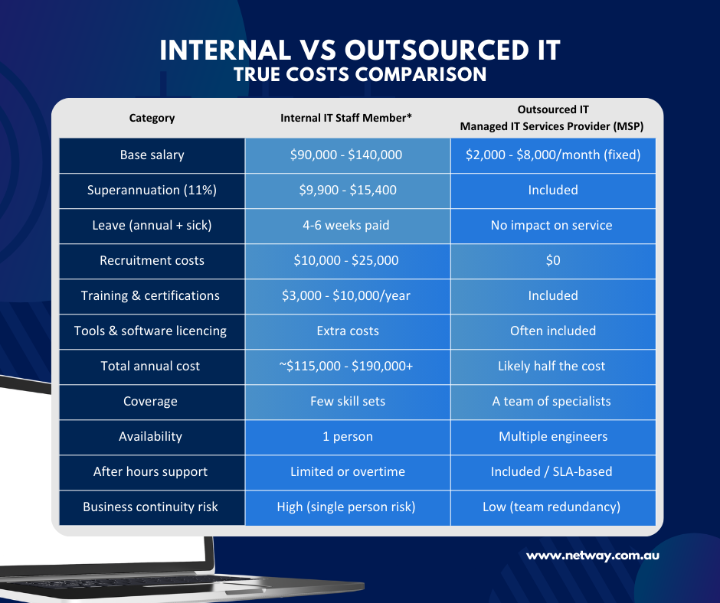
When you add base salary, superannuation, annual and sick leave, recruitment fees, ongoing training and software licencing, a single internal IT hire typically costs between A$115,000 and A$190,000 per year* (before overtime, turnover and the gaps in coverage that come from relying on one person).
* https://www.seek.com.au/career-advice/role/systems-engineer/salary